Something a little different, a little summery. This beautiful song was the first piece ever collected by composer Ralph Vaughan Williams, on 4 December 1903, from the singing of 70-year-old labourer Charles Pottipher in the village of Ingrave, Essex.
Though the song is often rendered very free rhythmically, ace folk-dance band Blowzabella present this more rhythmic but subtle arrangement. Fiddler Dave Shepherd lays out variations on the tune over Andy Cutting’s haunting accordion riff, before piper Paul James’ evocative singing.
I seem to have found the summer fiddle-singing project I was hankering after…
Blowzabella
Andy Cutting (diatonic button accordion), Jo Freya (vocals, saxophone, clarinet, whistle), Paul James (bagpipes, saxophones, whistle), Gregory Jolivet (hurdy-gurdy), Dave Shepherd (violin), Barn Stradling (bass guitar), Jon Swayne (bagpipes, saxophones, whistle)
Recorded at a dance in Stowmarket, Suffolk, May 2016.
West Virginia fiddler Rachel Eddy retitled her ‘favourite C tune’ – commonly known as Fourteen (or Sixteen, or Eighteen) Days in Georgia. There are many variations on the tune, so here’s just this one wonderful rendering from a 2016 concert in Peninsula, Ohio.
Hurdy-gurdy maestro Nigel Eaton’s haunting evocation of this ancient European wader, a frequenter of marshes and estuaries. A 3/8 bourée, he wonders…? Sounds good to me.
Nigel Eaton (hurdy-gurdy)
Played on a hurdy-gurdy made by his father, Chris Eaton.
An Old Time playing of an Irish tune by fiddler Bill Malley of County Clare, Ireland – first in a set with a stonking rendering of the upbeat E-B-E Reel, composed by Irish-American fiddler Liz Carroll.
As well as additional notes on these musicians and tunes, video-poster secondcousincurly writes a fascinating piece here on the importance of fiddle camps to American traditional music.
This set was the encore at a private notloB Parlour Concert in Watertown, Massachusetts. Note Brittany Haas’s five-string fiddle!
(‘BRITTANY HAAS & FRIENDS: Bill Malley’s Barndance & E-B-E Reel’, YouTube video 6.59. Posted by secondcousincurly, 28 Aug 2013. https://www.youtube.com/watch?v=XMf4IjPoJJY)
In eighteenth-century England, the two John Walshes*, father and son, dominated music publishing. John Walsh Snr was printing engraved music on The Strand, London, by 1690, and later John Walsh Jnr won what we would now call ‘exclusive rights’ to Handel’s music.
Clark’s was first published in the Walshes’ 1730 tunes collection, under the snappy title The Third Book of the most celebrated jiggs, Lancashire hornpipes, Scotch and Highland lilts, Northern frisks, Morris’s and Cheshire rounds with hornpipes the bagpipe manner, to which is added the Black Joak, the White Joak, the Brown,, the Red, and the Yellow Joaks. With variety of whims and fancies of diff’rent humour, fitted to the genious of publick performers.
Perhaps they took editorial advice, or wanted to pay their engraver less, but the reprint title shrank to Three Extraordinary Collections, Early 18th century dance music for those who play publick.
Well, ‘those who play publick’ are still playing the Walshes’ tunes – and this particular hornpipe is one of my favourites.
Alma
Emily Askew (fiddle), John Dipper (fiddle), Nicola Lyons (fiddle), Adrian Lever (guitar)
Gorgeously textured performance by the London-based fiddle group at Sidmouth Folk Week 2015.
Becky Price (accordion), Tim Perkins (bouzouki/guitar), Richard Heacock (fiddle/viola), Daniel Wolverson (fiddle/viola)
This utterly danceable version is from the group’s 2008 album Feet, Don’t Fail Me Now, available on Spotify (the link is to the full album; it seems impossible to link to the single tune). You can find the sheet music for the tune in their first collection of English and Welsh country dance tunes The Boldwood Dancing Master, available from their website (see below).
Originally a bawdy ballad, there are two basic versions of this Appalachian Kentucky tune, some more crooked than others. I love Premo & Gustavsson’s rendering for the hauntingly off-world sounds from their uncommon pairing of indigenous Swedish and American folk instruments.
This version of the melody is usually played in Dm, but here it’s in Am. Fiddlers generally play it cross-tuned*. Laurel Premo says of her gourd banjo: ‘I use a version of the “double c” tuning. The gourd banjo is a few steps lower from the standard banjo tuning, but the relationships on the strings are the same as you’d find in double C.’
The tune has an interesting thread on banjohangout
*For more information on cross-tuning, see post Newt Payne’s Tune, and/or Search ‘cross-tuning’ to find other cross-tuned melodies.
Premo & Gustavsson
Laurel Premo (gourd banjo), Anna Gustavsson (nyckelharpa)
The duo will be releasing an album this autumn – and I’ll be featuring a tune from it as soon as it’s available.
In the meantime, you can find out more about their many other projects here:
Laurel Premo:website (Fiddletails has also featured Laurel’s acclaimed duo Red Tail Ring – use the Search box to find posts of their compelling music.)
Two great London gigs a stone’s throw from Kings Cross, with Fiddletails-featured musicians as you’ve probably never seen them before!
Gadarene
Kings Place, Friday 29 April, 10-11.15 pm
Info and tickets here(Note late performance times – but Kings Place is only a short walk from Kings Cross tube.)
Fiddler Laurel Swift clogs and swings double bass in this extraordinary band playing ‘ultra-modern ancient music that’s wild enough to dance to! Gadarene transform obscure English 18th and 19th-century tunes with arrangements drawing on styles from funk and reggae to electronic and trance. With clogs and drums, mandolin, double bass, fiddle and flute, the band celebrate the release of their new CD’.
A tune from Playford’s The Dancing Master, 1686 (also known as A Trip to Kilburn – originally the name of the dance that belongs to the tune).
The Round has a good piece on the Playford tunes and dances – ‘melodies that set a-tapping the toes of Charles II, Henry Purcell and Samuel Pepys,’ says Mary Anne Ballard of the Baltimore Consort.
So, here’s Black and Grey played by quartet Boldwood, followed by a slower version on mandolin that’s perfect for catching the tune by ear.
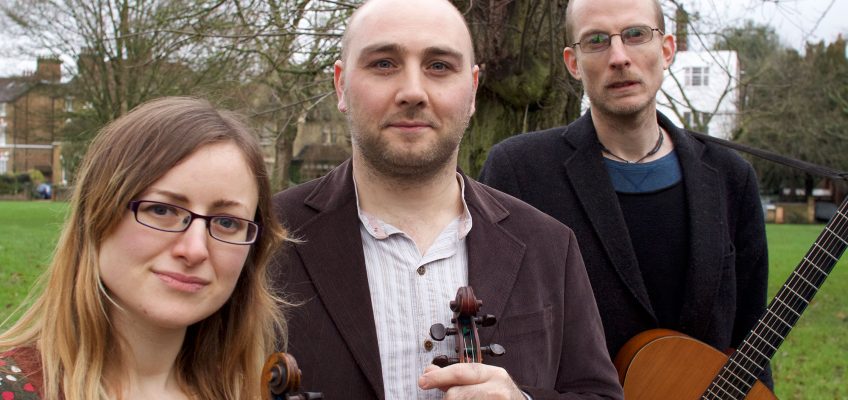
Boldwood
Becky Price (accordion), Daniel Wolverson (viola), Matthew Coatsworth (fiddle), Kate Moran (fiddle)
Sadly no name or contact details for this accomplished mandolinist, whose YouTube video notes quote interesting dates and information for the tune from The Fiddler’s Companion.
(‘Black and Grey or A Trip To Kilburn (Playford, 1686), on mandolin’ YouTube video, 0.58. Posted by Folk and Classical Mandolin, 27 Nov 2010.https://www.youtube.com/watch?v=_1dHP5cJQvc)
Boldwood: for CDs, gigs and other news, see their websiteFacebook
Also available from their website is the brilliant TheBoldwood Dancing Master, a book of over 70 English country dance tunes from 1679 to 1838.
Andy Fitzgibbon teaches a lively 3-part, crooked Kentucky tune as played by fiddler William Hamilton Stepp in 1937. The fiddle is cross-tuned AEAE, giving that characteristic Old Time ring from the sympathetic drone strings. (More on Bill Stepp and cross-tuning below.)
Andy Fitzgibbon (fiddle)
Teaching video for the 2014 Cowan Creek Mountain Music School advanced fiddle class.
‘Fiddler Bill’ Stepp (1845–1947), of Magoffin County, Kentucky, was the last fiddler to be captured on disc machine by Alan and Elizabeth Lomax during their Kentucky song-collecting expedition. He was a close friend of fiddler John Salyer (see ‘Last of Harris’).
Just a few places left on this amazingly good workshop with fiddler/composer/dancer Laurel Swift. Fabulous teaching, playing and walking (and food!) in an unspoilt Lincolnshire village – the kind of weekend where you play your socks off and go home feeling as though you’ve had a week’s holiday.
Don’t forget your walking shoes as well as your instrument/s!
Every couple of weeks or so I feature a tune that's caught my fancy – audio/video clips of brilliant musicians playing great, perhaps uncommon tunes to learn by ear. Most are from the English and American Old-time traditions; some hail from other musical worlds ‒ Scandi, perhaps, or French. But whatever you play ‒ fiddles or frets, free-reeds or fipples ‒ I hope you enjoy catching these wonderful tunes!




 Jenny Glover's FIDDLETAILS