It’s been a longer break than I’d hoped, but here I am again – and there are more tunes to come to celebrate Christmas and New Year.
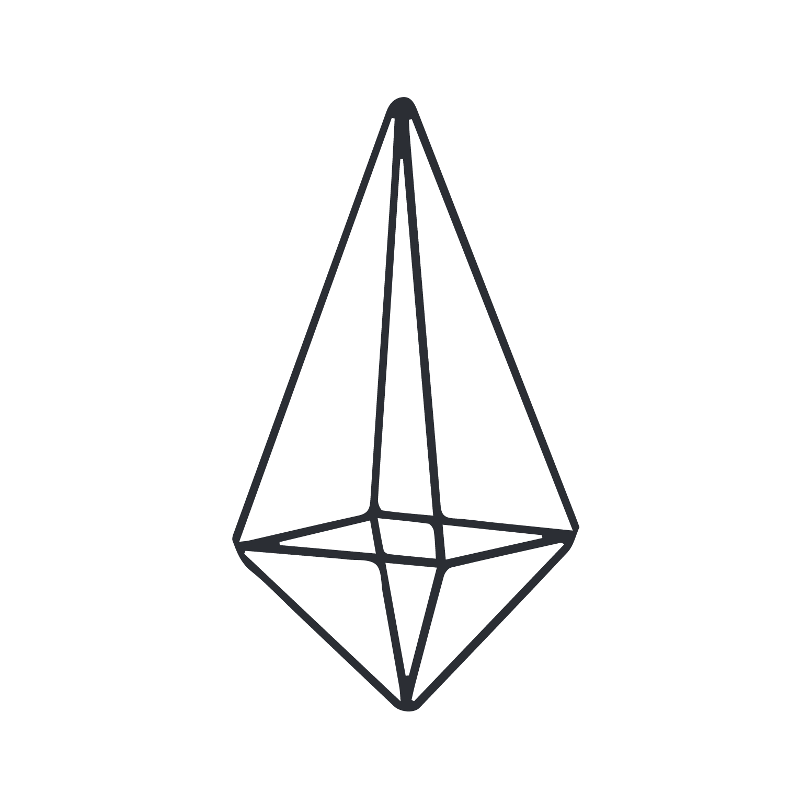
My first Christmas post is this sprightly set of jigs played and sung in wonderful harmony by Finnish folk band Himmeli – named for the traditional Finnish geometric ornaments made of straw hung above dining tables from Christmas to midsummer to ensure a good crop in the coming year.
I Saw Three Ships (trad. English)
On lapsi syntynyt meille (There is a child born to us) (trad. Finnish)
Sussex Carol (trad. English)
Himmeli
Markus Asunta (flute), Jaakko Kyrö (octave mandolin), Paula Susitaival (fiddle), Anni Tolvanen (nyckelharpa, vocals)
My tunes posts have got very irregular over the last few weeks, and I’m afraid won’t be back to a normal weekly run for a few more. I will post something new as and when I can, but for the time being I’m deep in manuscript edits that take every spare minute of computer time my eyes, brain and back can stand.
I’m delighted to see some followers revisiting previous posts – there are a couple of dozen great tunes on there, so please do go browsing if you’re feeling peckish for a tune or two.
Looking forward to coming back to regular Fiddletailing soon. Until then, happy music to you all – and thanks so much for tunecatching with me!
Breezy hornpipe that may have travelled to American and back* before arriving in the playlist of Boldwood’s unissued 2012 album Mudlarking. (*see Matthew Coatsworth’s Folkmusicnotes)
Boldwood
Becky Price (accordion), Miranda Rutter (fiddle, viola), Matthew Coatsworth (fiddle, viola)
Boldwood’s wonderful CDs are available on their website – along with marvellous tunes book The Boldwood Dancing Master, ‘a collection of English country dance tunes from 1679 to 1838’.
Current details of recordings, concerts etc are also on their Facebook page.
Use the Search box above to find other great Boldwood tunes.
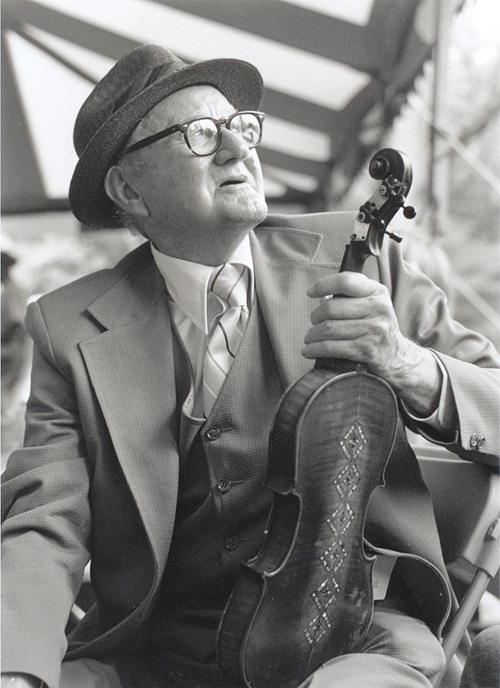
This week, I’m beginning with a story: acclaimed West Virginia fiddler Ernie Carpenter talking about his fiddling heritage handed down by his father and grandfather, a maker of dugout canoes on Elk River, West Virginia.
In this fascinating 1987 reel-to-reel audio recording, Ernie tells his tale, and goes on to play one of his grandfather’s tunes – the jauntily crooked Granddad’s Favorite.
Ernie’s father, Shelt Carpenter, photographed around 1932.
The audio recording is followed by the video of the musical part of the same performance at the October 1987 Celebration of Traditional Music, Berea College.
And, last but by no means least, this week’s post is topped off by a wonderfully clear teaching video: Andy Fitzgibbon’s rendition of Granddad’s Favorite, as played by Ernie Carpenter.
You’ll notice that Granddad’s Favorite is a crooked tune, with extra bars when you least expect them. It also comes with two warnings for fiddlers:
In the recordings below, the fiddles are cross-tuned: Ernie Carpenter in GDGD, Andy Fitzgibbon in AEAE. If you’d like to try cross-tuning, you’re less likely to break a string tuning your two lower strings up to AEAE, than tuning your top two down a tone for GDGD, and then having to crank them back up again to standard/GDAE. (I speak from sad experience.)
And if you prefer to keep your fiddle in standard tuning, don’t try to copy the fingering in the video!
And now for our story. Are you sitting comfortably? Then Ernie will begin.
Andy Fitzgibbon plays with the Iron Leg Boys, and is part of the New Young Fogies project co-run by Anna Roberts-Gevalt (of Anna & Elizabeth: see ‘Billy in the Lowground’ 7 May 2015)
Ernie Carpenter‘s fascinating family history is outlined on the Berea College website.
For more of his music on Fiddletails, see ‘Gunboat’ (Sept 2015)
A beautiful light-and-shade waltz composed by English fiddler, bass-player and violist Laurel Swift, also widely known as a dancer, choreographer, composer, and inspirational teacher of all things musical. Laurel is playing here with duo partner, fiddler, melodeon-player and dancer Ben Moss (you may remember the tune from a May 2015 Fiddletails post which focused on the second tune in the set, Whitefrairs’ Hornpipe.)
Ben Moss & Laurel Swift play Walthamstow Folk Club, London, Sunday 25 October. Details and tickets here. (Highly recommended – they played and sang up a storm at their Green Note gig back in January 2015!)
More information on their website, and on Facebook, and Twitter (@FolkieBen, @Laurel_Swift). Oxford Folk Weekend has an interesting biography of the duo linked to a future gig in April 2016.
Current EP available from Ben & Laurel’s website, where you can listen to the great (free!) track No Money.
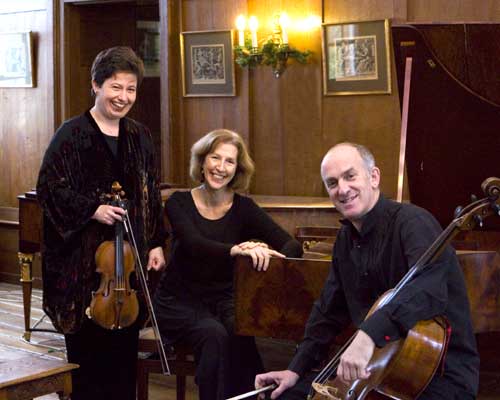
Maggie Cole (fortepiano), Kati Debretzeni (violin), Sebastian Comberti (cello)
My all-time favourite non-traditional ‘band’.
‘Trio Goya play Classical chamber music on period instruments… a collective fascination with the new colours and narratives that these instruments suggest…’ says the website.
In fact, they are one of those dynamic, fluid bands/groups/ensembles who play out of intense mutual listening, so that you’re drawn right into the heart of the music. One of the things I love about them is that you can often hear the common-or-garden dance roots in their classical pieces – a touch of the street from a time when music was music, and not cordoned off into discrete disciplines.
Fantastic musicianship from three truly great players – and a real treat for Fiddletails fiddle-followers in violinist Kati Debretzeni’s magical playing.
A rare London performance – do go if you possibly can!
Here’s an old-time treat for singers, fiddlers, fiddle-singers, banjo players – or indeed anyone who loves a great tune rendered as a slow air.
The Blackest Crow is known as an Appalachian tune. Lyle Lofgren comments on its origins: Versions of this song containing references to glass breasts and superlatively black crows have been collected in both Appalachia and the Ozarks. Some of these versions are diary entries dating from the time of the American civil war. Written copies of the words and the existence of multiple tunes indicate that the song was spread by broadside or newspaper publication rather than in the oral tradition.
Current versions of the tune mostly derive from the playing/singing of acclaimed North Carolina fiddler and banjo player Tommy Jarrell (1901-1985), whose working life was spent on road construction.
There are any number of versions of the lyrics, though the tune is generally unchanging. My three personal choices are each utterly individual. Enjoy!
Red Tail Ring
Laura Premo (fiddle), Michael Beauchamp (guitar)
Michigan multi-instrumentalists and master harmonizers, with ‘old-timey roots, new-timey sounds’. (Fiddle tuned down to EBF#C# – ie corresponding to standard tuning, but at lower pitch, with the tune fingered as though in standard key of G.)
Melodic virtuoso solo performance at the 2010 Sore Fingers Summer School, Oxfordshire, England. Adam’s rendition is so clear, it might just be the exception to the old rule that a fiddler should never learn a tune from a banjo player!
Red Tail Ring: currently on tour, with an unmissable Old-Time Ensemble Workshop in Downers Grove, IL, USA this Saturday, 3 October. Further details of that and remaining tour dates on their website, along with videos and downloads of their CDs.
Adam Hurt: for more information on gigs, recordings and online banjo teaching, see his website.
Tommy Jarrell: there is a wealth of information and recordings online, including an interesting biography here, and a lovely piece on his first fiddle now in the keeping of the Smithsonian.
Purlongs is an intriguingly crooked tune from Playford’s Dancing Master (1651), and the roots of its inscrutable title are much debated. (Andy Cutting’s definition: ‘Any distance travelled by a cat.’)
However, the word appears to be a Middle English variation of ‘purloin’ – to steal, in a stealthy manner:
Purlong: Middle English purloinen, to remove, from Anglo-Norman purloigner. Noun: purloiner. (Via thefreedictionary.com)
And there you have it. Purlongs. Thieves/robbers. Case closed?
(Perhaps not. Googling purlongs also gave me furlongs/corruption of, and instructions for installing purlins when putting up a roof.)
Cut to the chase! Here are two wonderful bands – Leveret and Boldwood – playing the lovely Purlongs.
Leveret*
Andy Cutting (melodeon), Rob Harbron (concertina), Sam Sweeney (fiddle)
Purlongs played second in a set with Whitefriars Hornpipe, which was the tune for 28 May (Purlongs: 2:50). Mr Cutting half visible but entirely audible.
The set is on Leveret’s 2015 CD New Anything, available from their website.
*GIG ALERT!
Leveret kick off their UK tour at Cecil Sharp House, London. THURSDAY 1 OCTOBER
Boldwood
Becky Price (piano accordion), Matthew Coatsworth, Kate Moran, Daniel Wolverson (fiddles)
Played second in a set with Fete de Village (Purlongs: 2:10) in a live performance at The Queen’s College Chapel, Oxford, 1st June 2013, featured on the unpublished CD Mudlarking**.
It’s one of those weeks when you can step up to the plate and learn a set of tunes, or just kick back and focus on one. Or of course just kick back…
Oss is an English trio playing English regional ‘gems and forgotten songs’ unearthed from manuscripts. The featured tune is John Dipper’s reworking of a traditional English tune, played second in a surprising set with the lovely ‘Dance’ from Purcell’s 1688 opera Dido and Æneas.
(Worlds collide for me this week — I sang chorus in this opera at school!)
Oss
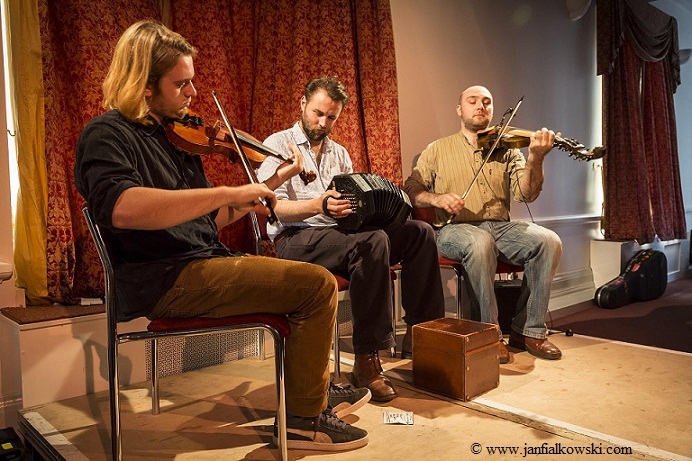
John Dipper (viola d’amore), Nick Hart (duet concertina, voice), Tom Moore (violin)
(When At War: 3:20)
The self-titled EP is available from the Oss website. You can also follow them on Facebook.
GIG ALERT!
Catch Oss live at Camden’s Green Note, MONDAY 21 SEPTEMBER
These guys really get around – here are just a few of their individual musical projects:
Nick Hart: melodeon and concertina player, multi-instrumentalist extraordinaire, maker of beautiful bones.
Co-hosts and teaches at East London’s great Trad Academy. (Look out for his amazing bones workshops, and read the fascinating esoteric notes on his handmade bones in his online shop!)
John Dipper: English Acoustic Collective and multiple projects/collaborations, including:
Laurel Swift (fiddle, voice, clogs), Colin Cotter (banjo, stompbox), Jon Brenner (piano accordion)
The mighty Gloworms play their ‘shiny-bright English ceilidh’ at a rare Knees Up Cecil Sharp ceilidh tomorrow night, Friday 20 September, at Cecil Sharp House. 8-11pm, £10/£8 on the door.
Dance, stumble, or just sit and soak up their amazing rhythms. Make it if you possibly can!
Every couple of weeks or so I feature a tune that's caught my fancy – audio/video clips of brilliant musicians playing great, perhaps uncommon tunes to learn by ear. Most are from the English and American Old-time traditions; some hail from other musical worlds ‒ Scandi, perhaps, or French. But whatever you play ‒ fiddles or frets, free-reeds or fipples ‒ I hope you enjoy catching these wonderful tunes!







 Jenny Glover's FIDDLETAILS